Tuesday, August 20, 2013

Revamped English and Science SOL's throw Virginia through a loop, Math scores increase.

  When new standardized tests are given in any subject, you can usually expect a small decrease in scores for the first year or two as teachers adjust to the new testing strategies. The scores should begin improving again by the third year to the same levels seen in 2011-2012. There also may be a few other reasons why scores have dipped and those should be investigated. Here I will concentrate on my strength, Sciences.


  1. Teaching to facts and not teaching for complex synthesis. The old SOL's were highly fact-based tests. The newer tests are not that easy. They are more in-depth and require thought and strategy in solving the problems. They require a full understanding of scientific processes and how they are applied to realistic, everyday situations. Word on the teacher front in May was that this test killed the students while they were taking it. 
  2. Administrative bad attitudes. I know that it is difficult to be the boss. To constantly deliver bad news, or having a correctional meeting with a subordinate, or be held accountable for the performance of your whole team. But that is what it is about. Support. You capture more flies with honey than you do with vinegar! Remember that! 
  3. Lack of administrative support. There is a specific incident that occurred in a local Roanoke school system that I wish to tell you about. A friend of mine, who taught elementary science in 2009, was told by the head of the Science Department, that "we are not concentrating on elementary sciences." Looking at this past year's scores in that school and system-wide, it is apparent that this is the case. In light of the Obama administration's push for early education and STEM introduction in elementary systems, this kind of thinking is completely against the grain. Whether or not you agree with what is going on in education right now with the National Core Curriculum, it is essential that students are competitive in the sciences. 
  4. Don't blame technology. "The students aren't used to the new system." I heard that sentence a few times. If anything, today's students are soaked in technology. I highly doubt that they are afraid of a computer test. However, there is the sentiment that the student may be rushing through the tests and that has to be carefully monitored. Students, especially IEP recipients, will need breaks to avoid becoming supersaturated. 
  So why did students score better in Math this year? The test was revamped last year and most schools systems have caught up with the changes already. The computer-based system has been in place for a few years now, reducing any anxieties about the usability of the program. Click the link to the article where you will find links to school system reports. 

  Most of you know my personal feeling about standardized testing and exactly how the "prepare" students for college. There is not one single standardized test that prepares you for college coursework. The only thing that does is life, creative teachers, and a thirst for knowledge. Excellent teachers are not just teaching the content. They are guiding students and becoming their coaches and cheerleaders. 
  I have not heard one valedictorian speech that thanked the SOLs or SATs for the work that they accomplished in elementary through secondary school. Tomorrow I will discuss highly effective habits of successful college students and who they draw upon for their knowledge.

Monday, August 19, 2013

Classical Explorations Begins Series.

   You have to love the internet. I have met more people face-to-face by connecting with them online. So when my Facebook and Twitter friend, Elizabeth Markham, announced Classical Explorations, I thought, what a great idea! 

 
  Elizabeth homeschools her own mini-me and was looking for a solution for her daughter's request to spend more time in a classroom setting or getting to be around more kids. All homeschool parents understand this dilemma when they try to create a balance between giving a quality education and time for socialization. If you have a child in the 4-6 yr old category and Tuesday mornings are open, click the link above for more details! Space is limited!  

Friday, August 2, 2013

Weekly Pinterest Education Round-up

There is no shame in being addicted to Pinterest! Here, I will share a few pins from my Education Board that may be worth trying out at home or in the classroom!

Sheer Post-it Notes from 3M! Write in your books without the mess! 
Use this at the beginning of the year to get to know your students. Way more fun than a regular worksheet with a list of questions.
From teacherspayteachers.com: Get to know your students! How fun is this?
From Learning Ideas: Music, Science, and Crafts? Yes, please!


Thursday, July 25, 2013

Getting Ready for Back-to-School


Please comment on the blog if there are any school openings that you would like to see listed! I will add them as the requests come in! 

Disclaimer: Many of these ideas are ripped from a book called “Organize Now!” It has lots of great suggestions and divides the tasks up by week to make it easier for any home to become more organized.
§  Schedule all check-up appointments before back-to-school. Doctor, dentist, and eye care if necessary. Many schools require certain vaccinations in order to attend. Plus, if your child is going to engage in fall sports, they will need a physical before they can participate.
§  Create two “drop-zones.” Have issues with stuff getting thrown around as soon as the kids walk in the door? I think every parent has nightmares trying to control the “kid clutter.” I find that having a nice large trunk for backpacks and lunch bags is a great idea. It keeps the mess hidden and it makes these items to locate the next morning. Plus, it will make it easier to do the “backpack dump” so you can find the necessary paperwork/announcements/grades to help your child which becomes your second “drop-zone.” Have a letter tray nearby where the kids can place paperwork after the backpack dump. You may want to set up file folders labeled “Announcements”, “Graded Papers”, and “Sign and Return to School”.

§  Hang a white-erase board. List the child’s name, if you have more than one, and the subjects under the child’s name. If your child has a constant reminder of what needs to be done, they may be more eager to erase each task. You may want to set up a reward system such as 15 minutes of game/TV time for every task finished. Check over your child’s work. This will allow you to know what they are doing and whether or not they understand the material.
§  Designate a study location. Preferably away from any visual stimulus such as the TV or computer, unless the computer is needed for the homework. If you have more than one child, you may want to set up a card table that has all the supplies your children will need in the middle of the table. This makes it easier to clean up and contain.
§  Don’t over-schedule your child. Allow them to pick one or two activities to be involved in. Your child will know when they have surpassed their limit and they will let you know with a lot of push-back and negative behavior and attitude. But do push them to try a variety of activities while they are learning what they are interested in.
§  Poor morning attitude? Pump up the volume! Playing music in the morning may help put your child in the right from of mind for the rest of the day. Choose classic favorites like Motown or old Dance songs. I really like Beyonce’s “Move Your Body” and Chubby Checker’s “Twist“.
§  Give your child a break. I would come home in the afternoons and unwind for half an hour, grab a snack, and allow myself to clear my mind before diving into homework. Your child is not an automaton please don’t think that they can perform like one! Let them have another break when they accomplish difficult homework tasks. It’s difficult to switch your brain from Math to History in one fell swoop!

Wednesday, July 17, 2013

Organizing Your Student For School

It has been that time of the year since the 4th of July Back-to-School ads. Most students in the area will be heading back within the next month.  Whether or not your child had a successful year last year, both of you will want to look at how you would like to organize and be prepared for the upcoming school year. Let’s take a look at the possible organizational styles your child might have:

§  Over-achiever organization. If your child is more organized than you are, you may want to take notes from him or her! These kids are generally successful already and may not need much help because they already have a system down pat. These kids talk about their schoolwork, what is going on, and are open to discussion. However, if there was one particular class that was troubling or more difficult, you may want to explore different options.
§  So-so organizer. You start off the school year with a bang and then… well… what happened? I would say that the majority of students fall in this area. They begin the school year with good intentions and then they hit a few speed bumps as the year progresses. They start losing their homework and important papers, forget test dates, and find themselves in a pit of despair about school. For these kids, they need more guidance than the over-achiever organizer. My suggestion is to check in with them every day and help them keep up with their binders.
§  Clutter/Chaos organizer. Many of the kids that fall into this category are usually being treated for ADHD or some other form of neurological disorder. However, apathetic kids fall into this category as well. Parents who are permissive or non-existent (never see their child for more than an hour or two a day), may have passed on traits that center around a disorganized domain. However, parents can turn this style around with a lot of work. If your child has a learning disorder, then you will have to guide them more intensely everyday! That means going through the book bag and asking a lot of questions. As they reach later adolescence, they made need less and less guidance if you have helped them build a strong foundation in organization.


Here are some general tips for any style organizer for the upcoming school year.
§  Add bright colors. From binders to dividers to lined paper. Color-code by subject. It’s tougher to get down about school when you have bright colors to look at! Even helps those of us who are visually-impaired.
§  Use graph paper and colored pencils for science and math notes. Handwriting has gone the way of the dinosaurs in most school systems, leading to terrible penmanship and illegible notes. Graph paper helps make the notes more readable and colored pencils help highlight key points for review.
§  Make yourself available to your child every day. I know. It’s tough to do. But you made an unspoken commitment to your child the day they were born.
§  Make sure that a study zone is in place in your house. It should be well-lit with easy access to supplies. Supplies should include: three-hole punch, stapler w/staples, paper clips, binder clips, extra pens/pencils/colored pencils, glue, scissors, and extra paper.
§  Set studying for the same time everyday. If you and your child are having problems and do not have a tutor, don’t wait. Set up an appointment right away. It is much, much more difficult to help students with problems halfway through the semester than at the beginning. Most tutors can work in multiple subject areas if your child has multiple problems to work on.
These are a few of my favorite things:
§  Reinforced College-Ruled Filler Paper they also have Reinforced Graph Paper
§  Weekly Planner/Journal: your child may get this from his/her school on their first day

Tuesday, July 16, 2013

Nurturing Creativity


With all this talk on trying to measure creativity and intelligence, how should we nurture creativity? Many people do not think that they are creative, but we are all creative humans in one form or another. Remember back to my first blog post on Gardner’s Theory of Multiple IntelligencesEveryone has the capability to strengthen areas of intelligence that they are weak in. Listed below are a few examples on how to nurture your creativity.

§  Learn a new word a day. Use it three times in a sentence, correctly. It will never truly leave your memory once that word is used three times. Use the new word whenever possible. I love what we call “$20″ words. What does antidisestablishmentarianism mean anyways?
§  Learn a new musical instrument in only 15 minutes a day. That’s right. I tell all my students that they need at least 15 minutes a day of practice to maintain or learn new skills.
§  Learn a new language in 15 minutes a day. There is an interactive book series that makes this possible. You can also use audio CD’s in your car on your way to the doctor’s office or any other errand.
§  Scour the internet for projects. Most often, your local parks and recreation departments will have inexpensive classes in art, technology, or physical activities to enjoy.
§  Snag some friends and play board games or console games. Spending time with friends is a must to creativity. Learning from people whose perspective is different from yours allows you to create new solutions to problems.

  Why all this push for creativity? More and more studies are showing that if we remain active and learn new things, it promotes the connection of neural networks in the brain which may stave off the onset of Alzheimer’s disease. It also promotes a concept of lifelong learning which America really needs right now in order to fulfill the high technology jobs that are available that do not have enough qualified people to fill them. We are becoming a high tech nation and we have an important job to fulfill in the world economy.

Try some of these out this weekend!

Tuesday, July 2, 2013

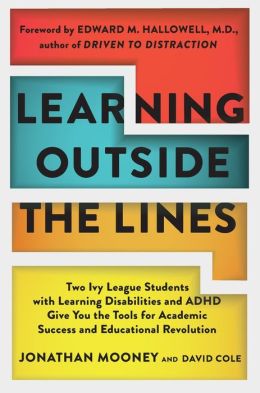
Book Review: Learning Outside the Lines

   Learning Outside the Lines may be a book meant for college students with Attention Deficit Disorder (ADD) but can be applied to any student who wants to be successful in college. It's a great guide for those who have been recently diagnosed with any learning disorder and how to navigate your way through the college life frenziness.
  The second section of the book is where I concentrated on reading the most. The authors guide you through note-taking, class discussions, writing papers, and doing well on exams. The book is very realistic since the authors wrote the book based on their experiences at Brown University. The book is set up for quick and easy reading with lots of bullet points for those of us that want to get what we need out of it and move on. Yes, built for short attention spans!
  I learned that I was making my system far more complex than it should be. Color-coding is a definite must and it will take some trial and error to figure our what works and what doesn't. I find a few simple steps will save a lot of time. Digging into the syllabus of your class is a must and so is better time management. I take each class syllabus that first day and plug in all the major tests and assignments into my calendar. If you are paper-based, use pencil. If you are computer-based, it will be easy to add and delete as you go along. I use paper-based in class because I don't always have my electronics on me to toss it into my Google+ calendar. I set aside time each day to add to the computer what is written on the paper-based calendar. Then I look at the upcoming month, estimate how long it will take for me to study and complete major assignments and I will schedule tasks that lead to the completion of each assignment. I also throw in an extra day on major assignments that allows for room to breath if I have a Murphy's Law day in which nothing is going right. I have been using my system since Spring semester and it was far more successful than the previous semester!
  Look this book up in your local library or head to your favorite bookstore and pick it up. Well worth the time and money invested!